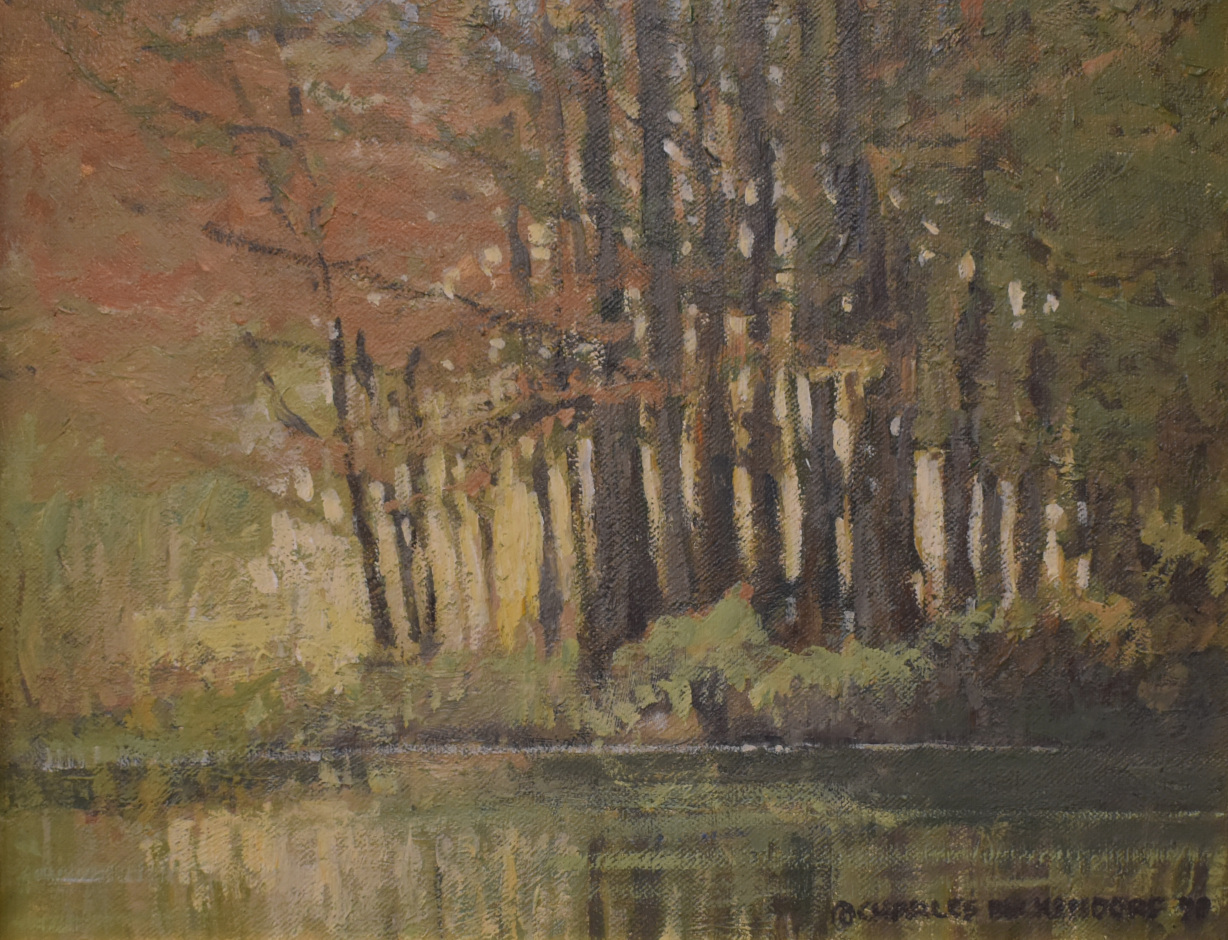
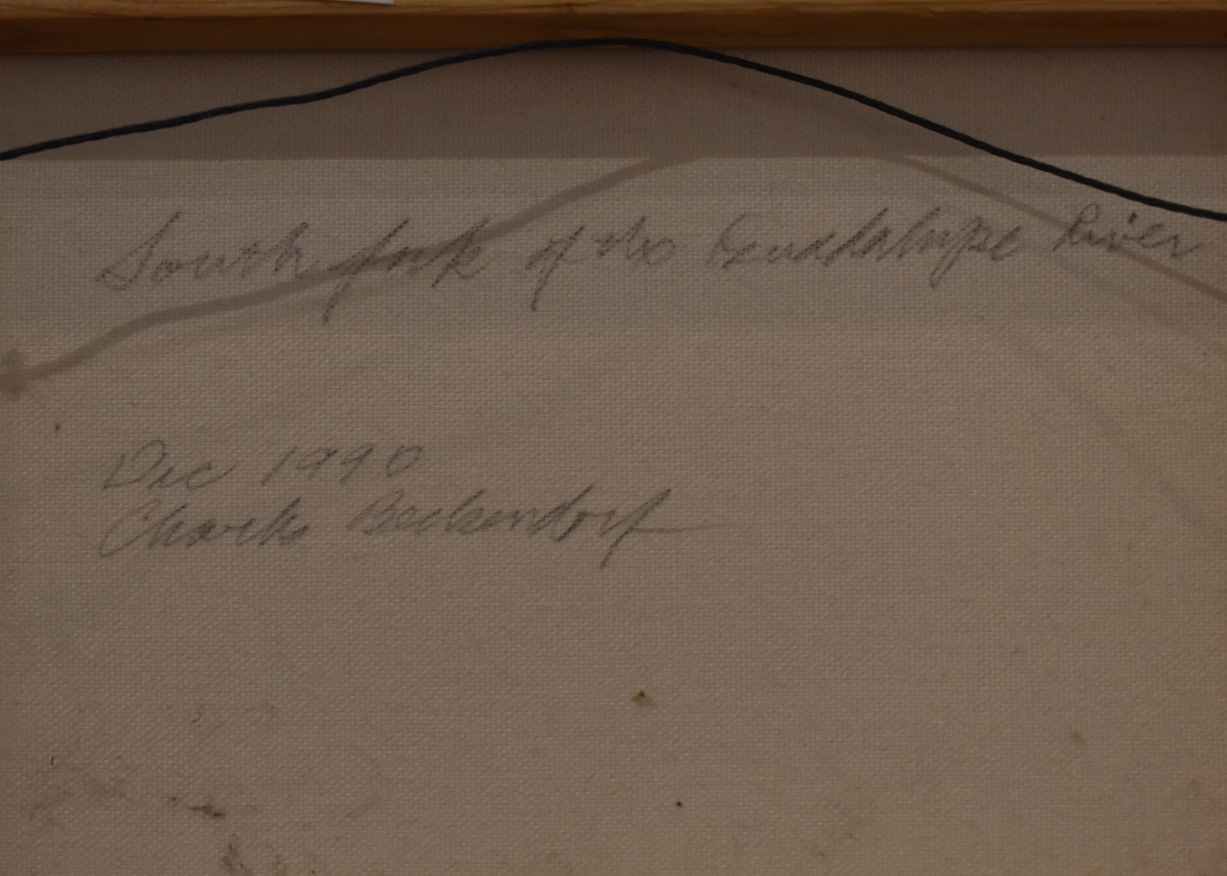
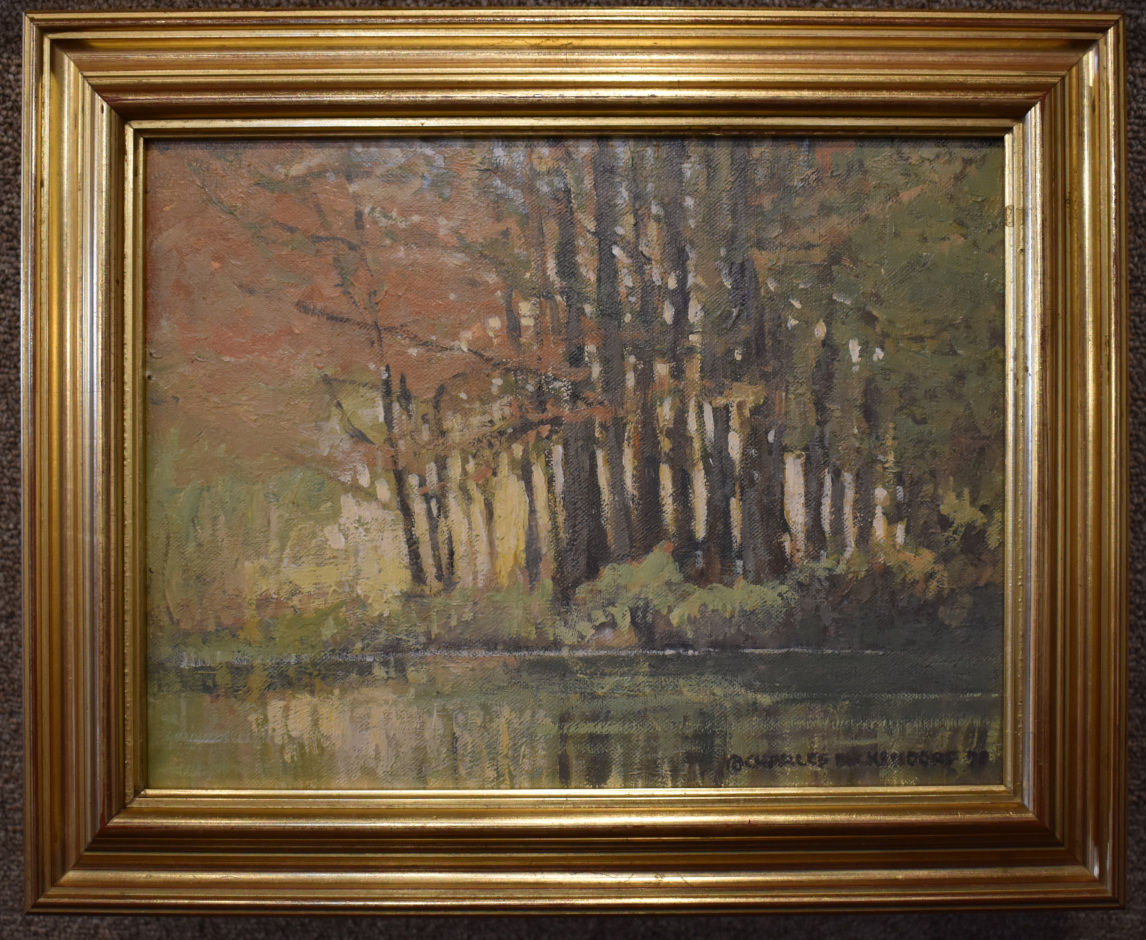
Charles Beckendorf "South Fork Of The Guadalupe River"
- Charles Beckendorf
- (1930 - 1996)
- Fredericksburg Artist
- Image Size: 9 x 12
- Frame Size: 12 x 15
- Medium: Oil on Canvas
- 1990
- "South Fork Of The Guadalupe River"
- Contact for Price & Info
- View All By This Artist
Details
Another fun original painting by one of Fredericksburg's well-known artists
The South Fork of the Guadalupe River is located in Kerr County Texas. It runs about 27 miles North before merging with the North Fork of the Guadalupe River creating the main
Guadalupe River.
South Fork Guadalupe River,
The South Fork Guadalupe River is the headwater stream of the Guadalupe River. It rises in the
southwestern part of Kerr County and flows north 27 miles to its junction with the North Fork
Guadalupe River forming the Guadalupe River at Hunt24. The South Fork Guadalupe River is
within the Edwards Plateau ecoregion. The segment begins 3 miles upstream of FM 187 in Kerr
County and continues downstream to its confluence with the Guadalupe River in Kerr County (Fig.
12). The ecological significance of the segment is based upon the following criteria:
1. Biological function– The aquatic and riparian habitats associated with the stream (Fig. 17)
support an exceptionally diverse assemblage of invertebrates, fish, reptiles, and birds
characteristic of the Edwards Plateau ecoregion. The riparian and canyon forests are
dominated by sycamore, willows, green ash, bald cypress, pecan, sugarberry/hackberry,
plateau live oak, Texas oak, Ashe juniper, and many other deciduous trees and shrubs.
2. Hydrologic function– Lynx Haven Springs are the source of the South Fork Guadalupe
River. These springs issue from the Edwards and associated limestone of the Edwards
Trinity (Plateau) Aquifer2. Several other springs contribute to South Fork Guadalupe River
baseflow. The entire segment is within the Edwards Aquifer drainage area. The riparian
habitats function to improve the quality of runoff and groundwater discharge into the river,
attenuate peak flood flows, and to some extent, stabilize base flows.
3. Riparian conservation area– None identified.
4. High water quality/exceptional aquatic life/high aesthetic value– The segment has high
water quality and is designated an exceptional aquatic life stream19. The segment also has
very high aesthetic value14. There are numerous rapids and limestone bluffs and
formations. The segment supports heavy recreational use.
5. Threatened or endangered species/unique communities– The following rare species
associated with aquatic or riparian habitats may occur in or along this segment although
most would not be restricted only to the segment habitats: Zone-tailed hawk (St.T),
Golden-cheeked warbler (Fed.E, St.E), Black-capped vireo (Fed.E, St.E), CagBiography
Charles Beckendorf(1930 - 1996)
During the 1960's, when Charles Beckendorf was thinking about launching
his first series of prints, the public was not as educated in art as
they are today. Charles knew that his subject matter would have to
appeal to the majority. He also knew that his products had to be priced
so that anyone could afford to purchase what he created. He felt that if
people started buying inexpensive prints and visiting art galleries,
they would develop a taste for art, and in time would become serious art
buyers. He was right… People have developed a taste for quality art.
Charles
grew up in Mathis, Texas, where he had the opportunity to spend hours
on large ranches. Generous land owners gave him permission to wander
freely over their ranches and he observed creatures in their natural
surroundings. He developed a lifelong love of nature, whether it be in
the tiniest of flowers or the largest of animals. It was at this time
that he became a true naturalist.
Art classes were not offered in
the Mathis schools, and most of Charles’ teachers were annoyed with his
innate interest in drawing. He was told that he “would never amount to
anything” if he just sat around drawing. After graduating from high
school in 1948, he enrolled in the University of Corpus Christi and
delightfully discovered that he could actually major in art!
He
later attended Southwest Texas State Teachers College in San Marcos (now
Texas State University). It was there that he met his future wife, Dawn
Laurence.
After a year in San Marcos, Charles decided to enlist in the U.S. Air Force and serve during the Korean War Conflict.
Charles
and Dawn were married in 1951. A few years later- after Charles left
the Air Force- they moved to Austin, and Charles enrolled in the
University of Texas where he earned a Fine Arts Degree.
For
several years Charles worked as a technical illustrator. He then did
advertising art and illustrations for many companies including Lone Star
Beer and Texas Game and Fish Magazine.
In the early 1960's
Charles and Dawn moved their family- which now included five children-
to Houston. Charles did a series of pen and ink prints as a trial to see
if there would be an interest and to see if anyone would buy them.
There was indeed an interest and they sold very well!
In 1965,
the Beckendorfs moved to the Texas Hill Country near Fredericksburg.
Charles released his second series of prints which were also from pen
and ink drawings of animals. He sold these prints wholesale to different
businesses- sporting goods stores, restaurants, icehouses, art
galleries- throughout the state of Texas.
Charles then
individually water colored 100 of each of the 13 subjects. Since these
hand water colored prints sold out quickly, he realized there would
probably be a demand for full color reproductions of paintings.
Since
clients from around the state traveled to Charles’ residence outside of
Fredericksburg to purchase his prints and paintings, he thought perhaps
he should have a gallery in town. He said, “Any fool artist who opens
an art gallery in Fredericksburg, Texas, should open on April Fool’s
Day”. On April 1, 1971, Charles and Dawn opened their first gallery.
From
the very first black and white prints of 1964 through April of 1996-
when Charles passed away- he painted thousands of originals in all
mediums, produced over 1500 different prints, sculpted several bronzes
and created six books.
The legacy of Charles Beckendorf lives on in his art.