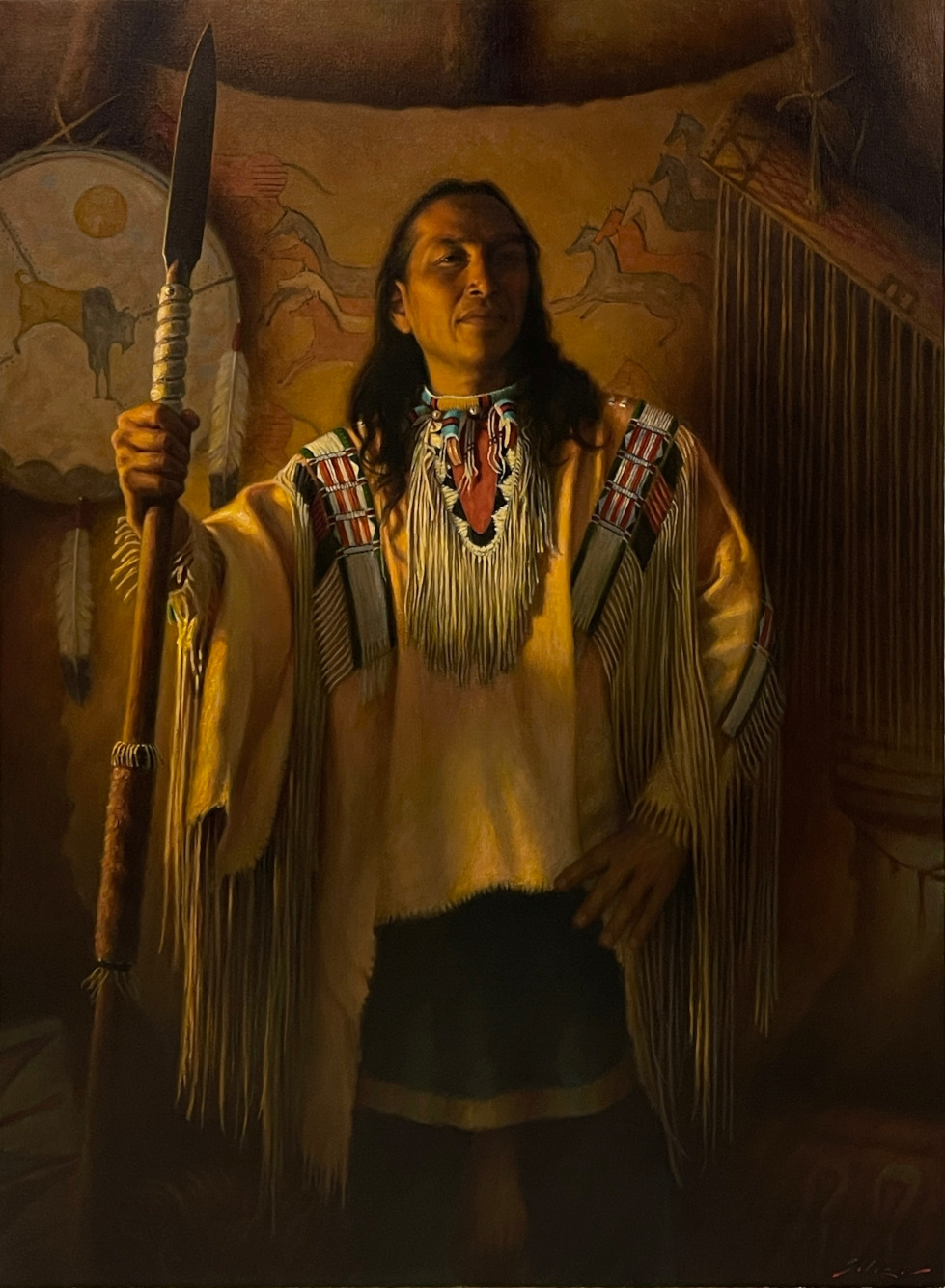
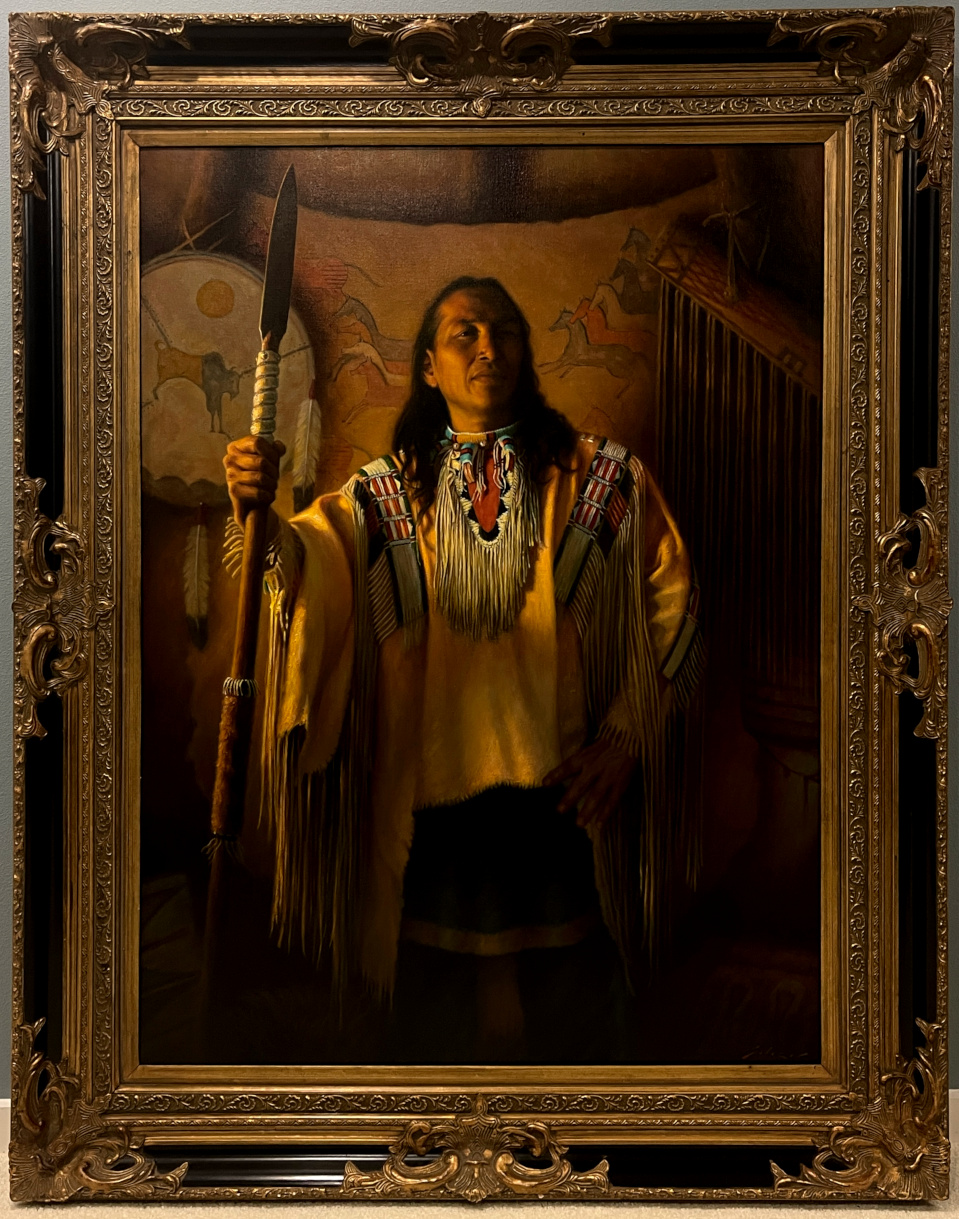
E. Salazar "The Pride of the Nez Perce" Native American Indian
- E. Salazar
- Texas Artist
- Image Size: 48 x 36
- Frame Size: 58 x 46
- Medium: Oil on Canvas
- "The Pride of the Nez Perce" Native American Indian
- Contact for Price & Info
- View All By This Artist
Details
Native American Indian, Western.
The Nez Perce nimíipuu, meaning 'we, the people') are an Indigenous people of the Plateau who still live on a fraction of the lands on the southeastern Columbia River Plateau in the Pacific Northwest. This region has been occupied for at least 11,500 years.
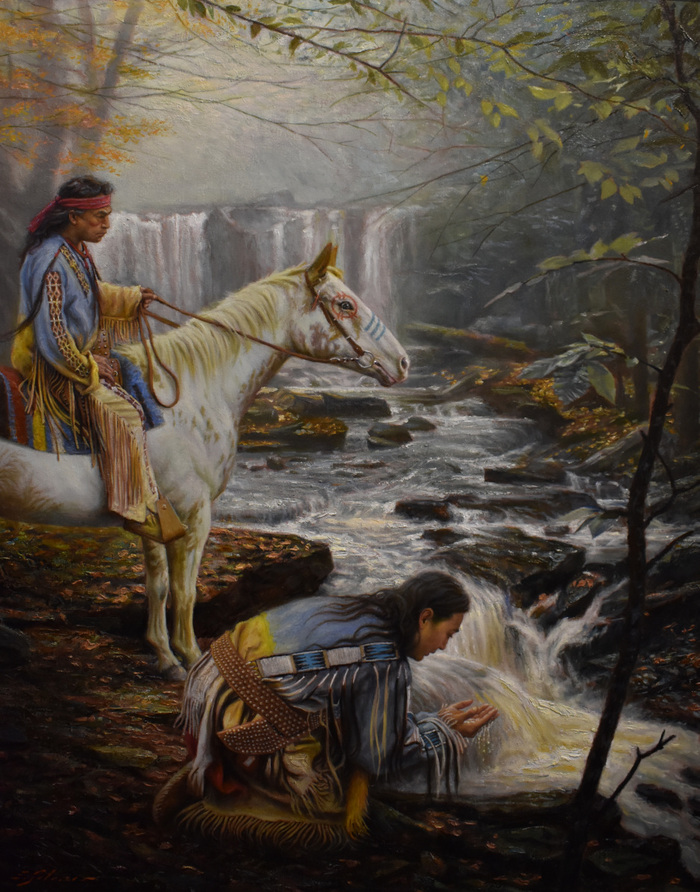
Members of the Sahaptin language group, the Nimíipuu were the dominant people of the Columbia Plateau for much of that time, especially after acquiring the horses that led them to breed the Appaloosa horse in the 18th century.
Prior to first contact with European colonial people the Nimíipuu were economically and culturally influential in trade and war, interacting with other indigenous nations in a vast network from the western shores of Oregon and Washington, the high plains of Montana, and the northern Great Basin in southern Idaho and northern Nevada
French explorers and trappers indiscriminately used and popularized the name "Nez Percé" for the Nimíipuu and nearby Chinook. The name translates as "pierced nose", but only the Chinook used that form of body modification.
Cut off from most of their horticultural sites throughout the Camas Prairie by an 1863 treaty (subsequently known as the "Thief Treaty" or "Steal Treaty" among the Nimíipuu), confinement to reservations in Idaho, Washington and Oklahoma Indian Territory after the Nez Perce War of 1877, and Dawes Act of 1887 land allotments, the Nez Perce remain as a distinct culture and political economic influence within and outside their reservation.
As a federally recognized tribe, the Nez Perce Tribe of Idaho govern their Native reservation in Idaho through a central government headquartered in Lapwaii known as the Nez Perce Tribal Executive Committee (NPTEC). They are one of five federally recognized tribes in the state of Idaho. The Nez Perce only own 12% of their own reservation and some Nez Perce lease land to farmers or loggers. Hatching, harvesting and eating salmon is an important cultural and economic strength of the Nez Perce through full ownership or co-management of various salmon fish hatcheries, such as the Kooskia National Fish Hatchery in Kooskia or the Dworshak National Fish Hatchery in Orofino.
Some still speak their traditional language. The Tribe owns and operates two casinos along the Clearwater River (in Kamiah and east of Lewiston), health clinics, a police force and court, community centers, salmon fisheries, radio station, and other institutions that promote economic and cultural self-determination.
Name and history
Their name for themselves is nimíipuu, meaning, "we, the people", in their language, part of the Sahaptin family.
Nez Percé is an exonym given by French Canadian fur traders who visited the area regularly in the late 18th century, meaning literally "pierced nose". English-speaking traders and settlers adopted the name in turn. Since the late 20th century, the Nez Perce identify most often as Nimíipuu in Sahaptin. This has also been spelled Nee-Me-Poo. The Lakota/Dakota named them the Watopala, or Canoe people, from Watopa. After Nez Perce became a more common name, they changed it to Watopahlute. This comes from pahlute, nasal passage, and is simply a play on words. If translated literally, it would come out as either "Nasal Passage of the Canoe" (Watopa-pahlute) or "Nasal Passage of the Grass" (Wato-pahlute). The Assiniboine called them Pasú oȟnógA wįcaštA, the Arikara sinitčiškataríwiš. The tribe also uses the term "Nez Perce", as does the United States Government in its official dealings with them, and contemporary historians. Older historical ethnological works and documents use the French spelling of Nez Percé, with the diacritic. The original French pronunciation is, with three syllables.
The interpreters Sacagawea and Toussaint Charbonneau of the Lew and Clark Expedition mistakenly identified this people as the Nez Perce when the team encountered the tribe in 1805. Writing in 1889, anthropologist Alice Fletcher, who the U.S. government had sent to Idaho to allot the Nez Perce Reservation, explained the mistaken naming. She wrote,
It is never easy to come up with the name of an Indian or even of an Indian tribe. A tribe has always at least two names; one they call themselves by and one by which they are known to other tribes. All the tribes living west of the Rocky Mountains were called "Chupnit-pa-lu", which means people of the pierced noses; it also means emerging from the bushes or forest; the people from the woods. The tribes on the Columbia river used to pierce the nose and wear in it some ornament as you have seen some old fashioned white ladies wear in their ears. Lewis and Clark had with them an interpreter whose wife was a Shoshone or Snake woman and so it came about that when it was asked "What Indians are these?" The answer was "They are 'Chupnit-pa-lu'" and it was written down in the journal; spelled rather queerly, for white people's ears do not always catch Indian tones and of course the Indians could not spell any word.
In his journals, William Clark referred to the people as the Chopunnish, a transliteration of a Sahaptin term. According to D.E. Walker in 1998, writing for the Smithsonian, this term is an adaptation of the term cú·pʼnitpeľu (the Nez Perce people). The term is formed from cú·pʼnit (piercing with a pointed object) and peľu (people). By contrast, the Nez Perce Language Dictionary has a different analysis than did Walker for the term cú·pʼnitpeľu. The prefix cú- means "in single file". This prefix, combined with the verb -piní, "to come out (e.g. of forest, bushes, ice)". Finally, with the suffix of -pelú, meaning "people or inhabitants of". Together, these three elements: cú- + -piní + pelú = cú·pʼnitpeľu, or "the People Walking Single File Out of the Forest". Nez Perce oral tradition indicates the name "cú·pʼnitpeľu" meant "we walked out of the woods or walked out of the mountains" and referred to the time before the Nez Perce had horses.
Language
The Nez Perce Language, or Nimiipuutímt, is a Sahaptian language related to the several dialects of Sahaptin. The Sahaptian sub-family is one of the branches of the Plateau Penutian family, which in turn may be related to a larger Penutian grouping.
Original Nez Perce territory (green) and the reduced reservation of 1863 (brown)
The Nez Perce territory at the time of Lewis and Clark (1804–1806) was approximately 17,000,000 acres (69,000 km2) and covered parts of present-day Washington, Oregon, Montana, and Idaho, in an area surrounding the Snake (Weyikespe), Grande Ronde River, Salmon (Naco’s kuss) ("Chinook salmon Water") and the Clearwater (Koos-Kai-Kai) ("Clear Water") rivers. The tribal area extended from the Bitterroots in the east (the door to the Northwestern Plains of Montana) to the Blue Mountains in the west between latitudes 45°N and 47°N.
In 1800, the Nez Perce had more than 70 permanent villages, ranging from 30 to 200 individuals, depending on the season and social grouping. Archeologists have identified a total of about 300 related sites including camps and villages, mostly in the Salmon River Canyon. In 1805, the Nez Perce were the largest tribe on the Columbia River Plateau, with a population of about 6,000. By the beginning of the 20th century, the Nez Perce had declined to about 1,800 due to epidemics, conflicts with non-Indians, and other factors. The tribe reports having more than 3,500 members in 2021.
Like other Plateau Tribes, the Nez Perce had seasonal villages and camps to take advantage of natural resources throughout the year. Their migration followed a recurring pattern from permanent winter villages through several temporary camps, nearly always returning to the same locations each year. The Nez Perce traveled via the LoLo Trail (Salish: Naptnisaqs- "Nez Perce Trail” (Khoo-say-ne-ise-kit) as far east as the Plains (Khoo-sayn / Kuseyn) ("Buffalo country") of Montana to hunt buffalo (Qoq’a lx) and as far west as the Pacific Coast (‘Eteyekuss) ("Big Water"). Before the 1957 construction of The Dalles Dam, which flooded this area, Celilo Falls (Silayloo) was a favored location on the Columbia River ("The Great River") for salmon-fishing. The Columbia Basin Initiative aims to improve salmon-fishing for the tribe.
Enemies and allies
The Nez Perce had many allies and trading partners among neighboring peoples, but also enemies and ongoing antagonist tribes.
To the north of them lived the Coeur d’Alene (’Iskíicu’mix), Spokane (Heyéeynimuu/Heyeynimu - "Steelhead [Eating] People"), and further north the Kalispel (Qem’éespel’uu/Q'emespelu, both meaning "Camas People" or "Camas Eaters"), Colvillee (Páapspaloo/Papspelu - "Fir Tree People") and Kootenay (Kuuspel’úu/Kuuspelu - "Water People", lit. "River People").
To the northwest lived the Palus (Pelúucpuu/Peluutspu - "People of Pa-luš-sa/Palus [village]") and to the west the Cayuse (Weyíiletpuu – "Ryegrass People"), west bound there were found the Umatilla (Hiyówatalampoo/Hiyuwatalampo), Walla Walla, (Wecq’úupuu) and Sk'in (Tike’éspel’uu) and northwest of the latter various Yakama bands (Lexéyuu).
To the south lived the Snake Indians(various Northern Paiute bands (Hey’ǘuxcpel’uu) in the southwest and Bannock-Norther Shoshone) bands (Tiwélqe/Tewelk'a, later Sosona') in the southeast).
To the east lived the Lehmi Shoshone (Lémhaay), north of them the Bitterroot Salish Flathead (Séelix/Se'lix).
Further east and northeast on the Northern Plains were the Crow (’Isúuxe/Isuuxh'e - "Crow People") and two powerful alliances – the Iron Confederacy (named after the dominating Plains and Woods Cree and Assiniboine (Wihnen’íipel’uu), an alliance of northern plains Native American nations based around the fur trade, and later included the Stoney, Wester Saulteaux (Sat'sashipunu/Sat'sashipuun - "Porcupine People" or "Porcupine Eater"), and Metis) and the Blackfoot Confederacy (’Isq’óyxnix/Issq-oykinix - "Blackfooted People") (composed of three Blackfoot speaking peoples – the Piegan, the Kainai of Bloods, and the Siksika or Blackfoot, later joined by the unrelated Sarcee and (for a time) by Gros Ventre.
The feared Blackfoot Confederacy and the various Teton Sioux (Lakota) (Iseq'uulkt - "Cut Throats") and their later allies, the Cheyenne (T'septitimeni'n - "[People with] Painted arrows"), were the main enemies of the Plateau peoples when entering the Northwestern Plains to hunt buffalo.
Biography
E. Salazar
Salazar is a classically trained painter whose work draws deeply from historical, cultural, and spiritual themes. He began his formal art education at age 18 at St. Petersburg College in Florida, later moving to New York in 1984, where he spent two decades as a successful illustrator. Specializing in Biblical and historical subjects, he created more than 300 paintings featured in internationally circulated books, journals, and calendars.
Alongside his commercial career, Salazar nurtured a lifelong passion for classical portraiture. He studied under renowned artists such as Nelson Shanks at the New York Academy of Art and participated in workshops with Everett Raymond Kinstler and Max Ginsburg at the Art Students League of New York. He also learned from masters like John Howard Sanden, Richard Schmid, and Daniel Greene, while drawing deep inspiration from historic figures including John Singer Sargent, Jules Bastien-Lepage, and Diego Velázquez.
Salazar’s portraits include public figures such as Vanessa Williams, Rick Fox, Mark Martin, Gato Barbieri, and Lionel Hampton. His work has been exhibited at the prestigious Salmagundi Club in New York and is held in private and institutional collections across the Americas, Europe, and Asia.
As an educator, Salazar has shared his expertise through art history lectures at the Metropolitan Museum of Art. He has been recognized in Marquis Who’s Who for both artistic achievement and educational impact.
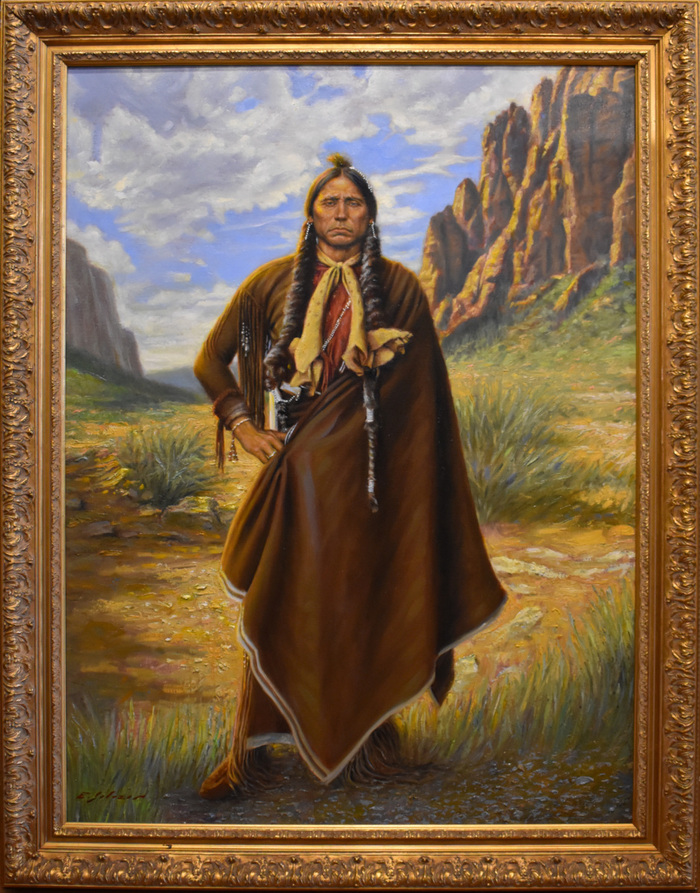
Now based in Texas, Salazar is currently focused on painting Western and Native American subjects. He is represented by The Charles Morin Fine Art Gallery in Fredericksburg, Texas, and his work is part of the permanent collection at the Museum of Western Art in Kerrville, Texas. At the heart of his practice is a message of respect—for personal identity, cultural beauty, and shared humanity. Through his paintings, he seeks to inspire reflection on our collective dignity and the enduring importance of peace among all people.